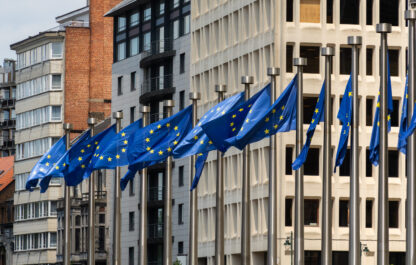
Most countries wish to attract highly qualified workers able to satisfy the demands of companies within their borders. The European Union is not an exception to this rule and wishes to appeal to workers from third-party countries. This includes the United Kingdom, and they sought to do so through the EU Blue Card permit.
Moreover, travel restrictions due to the COVID pandemic don’t affect this type of visa holder from entering the EU.
Requirements for the EU Blue Card
The European Council Directive of 25 May 2009, facilitates highly qualified migrants’ entry, stay, and employment lists the following requirements:
Proof that the employee has a high level of education or professional qualifications, either
in the form of a university degree or pertinent professional experience;
Benefits from an employment contract for one year or more with the host
country, member of the European Union; and
Benefits from a minimum annual gross salary stipulated by the host country.
This type of permit is designed to “simplify” immigration processes, for both the professionals and their family members. Spouses are usually also permitted to be employed in the host country.
Although this permit is adapted to stable employment over a long-term, workers may change companies if requirements are still met. Long stay or even permanent employment is possible for EU Blue Card permit holders.
Mobility implications for EU Blue Card Holders
It should be noted that certain European countries have not transposed this permit into their internal legal systems. Britain was one of them before leaving the EU.
Mobility between EU member states for holders of the EU Blue Card
The Blue Card Directive allows holders and families to transfer to other EU states after 18 months in the initial country. They must apply for a new Blue Card within one month, usually without needing a new visa.
As the EU is not one nation, member states are free to stipulate certain criteria, in particular the salary threshold for obtaining an EU Blue Card.
The discrepancies between countries are great (i.e. 71 946 Euro in Luxembourg, 53 836 Euro in France, 53600 Euro in Germany, 33 808 Euro in Spain, 24 789 Euro in Italy, etc.).
Sources: European Commission and VisaGuide.world.
Issues that may arise from EU Blue Card Eligibility
Even when the salary amounts are respected, other difficulties may arise when an EU Blue Card holder transfers to a new host country within the European Union. For example, they may only have temporary accommodation during their first month, which may not be accepted by the authorities delivering the new EU Blue Card, or the blue card application may take several months to produce, during which the applicants have no documentation authorising them to work in the new country, which is incompatible with judicial security.
Conclusion
It is clear that some effort is still needed to streamline inter-member state mobility for EU Blue Card holders within the EU. Companies have a role to play in lobbying for more flexibility in the field so that the idea behind the EU Blue Card Directive becomes easier to apply.
For more information on the EU Blue Card and all types of work permits and visas, contact us to speak to a member of our immigration team directly.
Share:
Company
Team Centuro
Centuro Global is an award-winning AI-powered SaaS platform for global expansion & global mobility, led by human expertise for tailored legal & compliance solutions. Our platform is a one-stop-shop hub for global expansion, providing companies with the tools, knowledge, and expertise to expand globally in any jurisdiction.
Centuro Global is proud to announce that we have won the ‘Best Business Travel Management’ award at the Forum for Expatriate Management’s (FEM) Americas Expatriate Management & Mobility Awards 2026 (EMMAs).
A guide for Authorising Officers, HR managers, and anyone responsible for managing a UK Sponsor License. This guide gives you a working understanding of your obligations as a sponsor licence holder, outlining the key duties you must follow and the consequences of non-compliance to ensure you maintain your licence.
The European Union’s new digital border control system, the Entry/Exit System (EES), is now fully operational across all Schengen Area borders as of 10 April 2026. This is a significant change in how British citizens and other non-EU nationals will enter and exit the Schengen Area, with major implications for business travel, compliance and border processes.
Centuro Global is an industry-leading platform for legal services
Discover how we can help your team with immigration, business travel and global expansion.
Get clear answers on business travel, immigration or global expansion - and find the right solution for your needs.
What to expect:
Quick review of your goals and challenges
Walkthrough of the features that matter most
Clear next steps, timelines, and pricing
Trusted by businesses in 170+ countries
Manage Cookie Consent
We use technologies like cookies to store and/or access device information. We do this to improve browsing experience and to show (non-) personalised ads. Consenting to these technologies will allow us to process data such as browsing behaviour or unique IDs on this site. Not consenting or withdrawing consent, may adversely affect certain features and functions.
Functional
Always active
The technical storage or access is strictly necessary for the legitimate purpose of enabling the use of a specific service explicitly requested by the subscriber or user, or for the sole purpose of carrying out the transmission of a communication over an electronic communications network.
Preferences
The technical storage or access is necessary for the legitimate purpose of storing preferences that are not requested by the subscriber or user.
Statistics
The technical storage or access that is used exclusively for statistical purposes.The technical storage or access that is used exclusively for anonymous statistical purposes. Without a subpoena, voluntary compliance on the part of your Internet Service Provider, or additional records from a third party, information stored or retrieved for this purpose alone cannot usually be used to identify you.
Marketing
The technical storage or access is required to create user profiles to send advertising, or to track the user on a website or across several websites for similar marketing purposes.