UK Sponsor Licence 2026: Everything You Need to Know
16 min read •
April 29, 2026
Share:
Home › Articles › UK Sponsor Licence 2026: Everything You Need to Know
How to use this guide
This guide gives you a working understanding of your obligations as a sponsor licence holder, outlining the key duties you must follow and the consequences of non-compliance to ensure you maintain your licence.
Latest update: Home Office reading requirement The Home Office now requires every Authorising Officer and Level 1 User named on a licence to demonstrate they have read the official guidance. Use the Guidance Reading Log (available separately) to record when each named person has read each document, and keep it on file.
This guide covers the standard Skilled Worker and Senior/Specialist Worker routes. If you are managing multiple GBM routes, TUPE transfers, or unusual employment arrangements, speak to Centuro before acting.
PDF Version
Get the PDF version of this guide
Download the full guide as a PDF for easy sharing and offline access.
What holding a Sponsor Licence means
When the Home Office grants you a sponsor licence, they are giving you permission to bring overseas workers into the UK. In return, you take on legal responsibility for every worker you sponsor. That means you are accountable for paying them correctly, monitoring their compliance, and reporting changes for the full duration of their permission.
The Home Office does not wait for things to go wrong before checking up. They conduct announced and unannounced compliance visits, and they now have direct access to HMRC payroll data. Non-compliance has real consequences for your workers and your business.
Licence rating
Rating
What it means in practice
A-rated
Full sponsorship rights. You can bring in new workers from overseas, employ from inside the country, and extend existing permissions.
B-rated (Probationary)
Restricted. You can only extend workers already in the UK on the same route. You cannot bring in anyone new. You will be placed on an action plan.
Falling to B-rated is serious. Getting back to A-rated requires demonstrating sustained compliance over time, and there is no guarantee.
Key personnel
Role
Who it should be
What they are responsible for
Authorising Officer (AO)
A senior, permanent employee — typically a director or senior HR lead. Cannot be a third-party agent.
Takes legal responsibility for the licence. Signs off on sponsorship decisions.
Key Contact
Can be the same person as the AO.
Primary point of contact with the Home Office.
Level 1 User
HR or operations staff with day-to-day SMS access.
Assigns CoS, submits reports, manages worker records in SMS.
Key Personnel changes If your AO or a Level 1 User leaves, you must update the SMS promptly. A licence with an absent or inactive AO is a compliance risk. There is no grace period.
Sponsor compliance as a business risk
Holding a sponsor licence goes way beyond being an administrative obligation — it’s an active business risk that requires structured oversight.
The Home Office has significantly expanded its enforcement capability. From April 2026, it has direct access to HMRC payroll data: salary discrepancies are identified automatically, without a complaint or a compliance visit being required. Compliance visits can be announced or unannounced, and inspectors review your entire workforce, not just sponsored workers.
The consequences of getting this wrong extend well beyond a regulatory penalty. A licence downgrade freezes your ability to hire internationally. Revocation means every sponsored worker loses their right to work in the UK and may need to leave. The Home Office publishes revocations publicly on a register that prospective employees, clients, and partners can view.
Sponsor compliance belongs in the same category as financial controls and data protection. It is a structured operational risk, not a task delegated to HR and forgotten.
Business impact of non-compliance
Outcome
Business impact
B-rating (downgrade)
No new overseas hires. International recruitment pipeline frozen. Action plan required. No guarantee of returning to A-rating.
Suspension
No new CoS can be assigned. Uncertainty for all workers currently on your licence.
Revocation
All sponsored workers lose their right to work in the UK. Workers may need to leave. Immediate and severe talent disruption.
Civil penalty (right to work failure)
Up to £60,000 per worker found to be working without the right to do so.
Public register
Revocations are published by the Home Office — visible to candidates, clients, and partners.
Managing your licence
Keeping your SMS up to date
Your SMS records must reflect reality at all times. This includes:
Contact details for all Key Personnel
Your registered business address
Any branches where sponsored workers are based
Details of any changes to your organisation
When someone in a Key Personnel role leaves or changes, update the SMS and appoint a replacement.
Reading requirements for Officers and Level 1 Users
The Home Office now requires every Authorising Officer and Level 1 User named on a sponsor licence to demonstrate that they have read the official sponsor guidance. During a compliance visit, UKVI may ask for evidence that your named users have done so.
Template
Download our free Reading Log template
Use this template to stay compliant with the Home Office's new reading requirements.
This is one of the most commonly missed obligations — and one of the most serious.
Sponsor licences are not transferable. If your company goes through any of the following, you must notify the Home Office — in most cases, a new licence application will be required:
Change of ownership (including private equity or management buyout)
Merger or acquisition
TUPE transfer where the employing entity changes
Significant change in shareholding structure
Critical If the Home Office discovers a change was not reported, they can revoke your licence. Every worker you sponsor would lose their right to work and their visas would be curtailed. If you are going through or planning any structural change, contact Centuro before it completes.
CoS allocation
Your Undefined CoS allocation renews each year. For most routes this renewal is automatic, at the same level as the previous year, provided you hold an A-rating and have an active allocation.
For some routes (Seasonal Worker, Service Supplier, Secondment Worker, UK Expansion Worker), renewal is not automatic. You must submit a manual renewal request up to three months before your allocation year ends. Unused CoS do not carry over.
Sponsoring a new worker
Who needs sponsoring?
You do not need to sponsor anyone who already has the right to work in the UK without restrictions. This broadly includes:
British and Irish citizens
People with Indefinite Leave to Remain (ILR) or EU Settled Status
People with the right of abode
Everyone else will generally require sponsorship. When in doubt, check — don’t just assume. You can always get help from Centuro Global by requesting a right-to-work assessment.
The Certificate of Sponsorship (CoS)
The CoS is not a physical document. It is a unique reference number you generate in the SMS and assign to a specific worker. The worker uses it to apply for their visa. Without it, they cannot apply.
Type
When it applies
Defined CoS
Worker is applying from outside the UK (Skilled Worker only). Must be individually approved by the Home Office before you assign it.
Undefined CoS
All other cases — including in-UK extensions and switches. Drawn from your annual allocation.
What must go on a CoS
You are legally responsible for the accuracy of every field. The CoS must include:
The worker’s personal details (name, nationality, date of birth, passport)
The occupation code (SOC 2020, 4-digit)
A job description that accurately reflects the actual duties
The work address or addresses
Average weekly hours
Start and end date
Salary
If you make a significant error such as putting in the wrong occupation code or incorrect details across more than one field, you will need to withdraw the CoS and issue a new one. The worker’s application cannot proceed on a flawed CoS.
Occupation codes
Every CoS requires the correct Standard Occupational Classification (SOC 2020) code for the role. This matters because:
The code determines the minimum salary (going rate) the worker must be paid
An incorrect code can delay or refuse a visa
Using a code that does not reflect the actual role to avoid a higher salary requirement is treated as fraud and will result in licence revocation
The Home Office will not help you choose a code. You are responsible for getting it right.
The start date rule
Once a worker’s visa is granted, they must start within 28 days of the latest of:
The start date on their CoS
The ‘valid from’ date on their eVisa
Notification that their permission has been granted
Most common compliance failure
If a worker cannot start within 28 days, even for a legitimate reason like a notice period, you must still report it to the Home Office within 10 working days of the deadline passing. Provide the new start date and the reason. Do not overlook this.
Fees
You pay the CoS fee. You also pay the sponsor licence fee. You cannot ask workers to reimburse these costs, directly or indirectly. This applies to Skilled Workers since December 2024. Recouping costs from workers in any form results in automatic licence revocation.
Once someone is on your licence
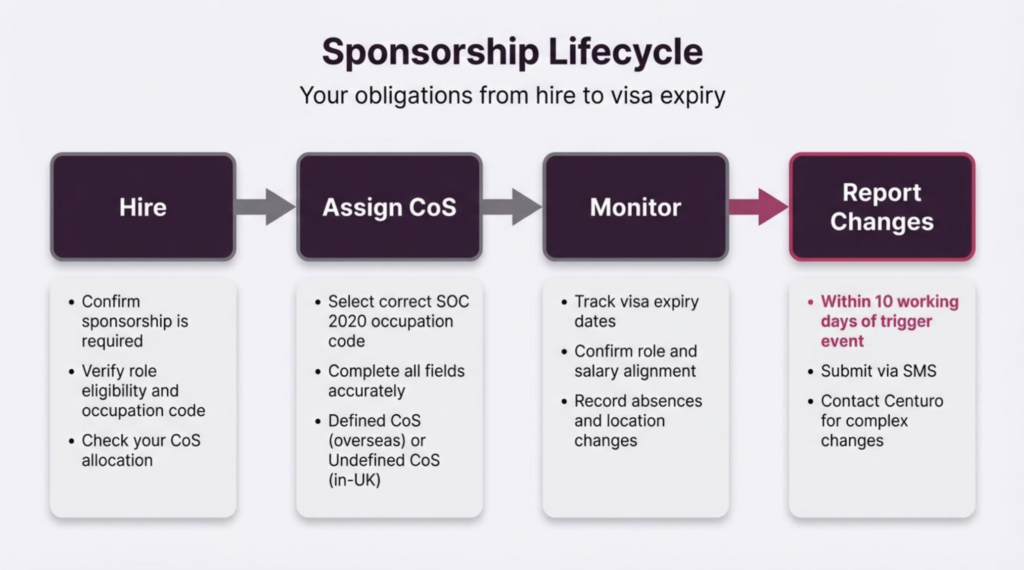
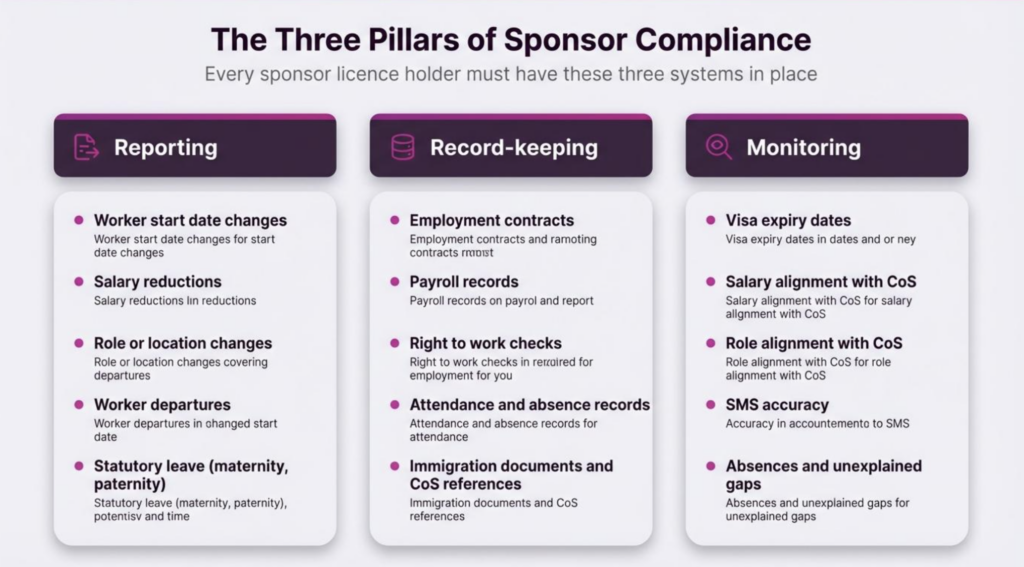
Sponsoring someone is not a one-time event. You have ongoing obligations for the full duration of their permission. Your ongoing obligations fall into three areas: reporting, record-keeping, and monitoring.
What to monitor
Attendance: track working days and flag unexplained absences promptly.
Visa expiry: know when each sponsored worker’s permission expires.
Role alignment: the worker must only perform the duties described on their CoS. If the role changes meaningfully, this must be reported.
Salary: pay what is stated on the CoS. Do not reduce it without reporting.
Salary changes
Salary increases do not need to be reported to the Home Office.
Salary decreases must be reported
Any reduction that brings a worker’s pay below what is stated on their CoS — including temporary reductions for any reason — must be reported. From April 2026, the Home Office has direct access to HMRC payroll data and will identify discrepancies automatically. If they find a worker is being paid less than their CoS states, the worker’s permission may be cancelled and your licence will be at risk.
What you must report
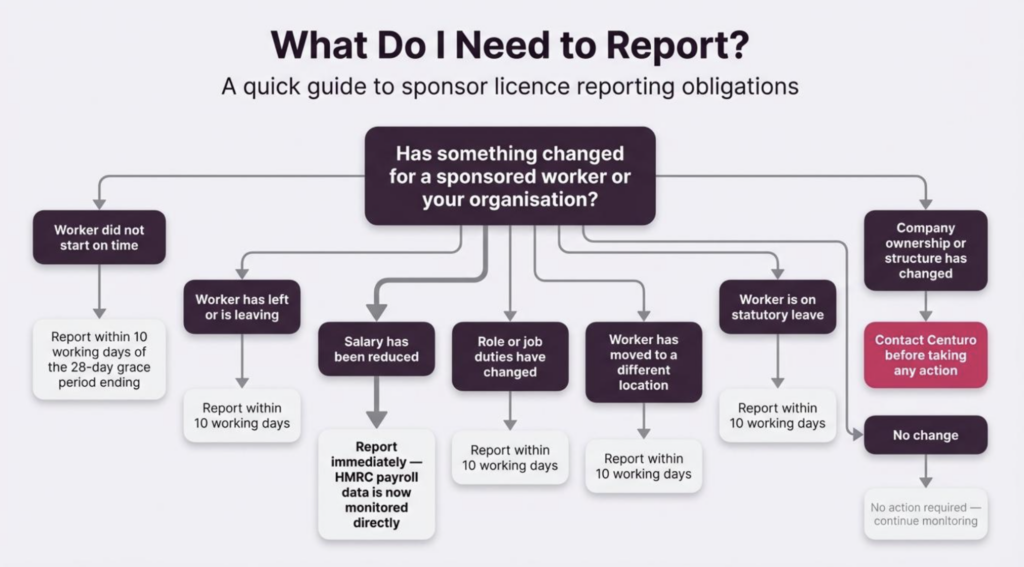
The following must be reported via the SMS, in most cases within 10 working days:
A sponsored worker does not start work after their visa is granted (after the 28-day grace period)
A worker is absent from work without explanation or permission
A worker leaves your employment, for any reason
A worker’s role changes from what is on their CoS
A worker moves to a different work location or branch
A worker goes on maternity, paternity, or other statutory leave
A significant change to the worker’s circumstances
Do not assume that if a situation is reasonable, you do not need to report it. The obligation to report and the acceptability of the underlying situation are separate questions. When in doubt, report it.
Right to work re-checks
For workers on time-limited permission, you must carry out a repeat right to work check before their permission expires. If you do not, you lose the legal protection that a right to work check provides and may be liable for a civil penalty.
Record keeping
Your records are your evidence. If UKVI asks to see something during a compliance visit and you cannot produce it, they will treat that as non-compliance — even if you were compliant in practice.
Record
What to retain
How long
Right to work checks
Copy of documents checked; date of check; method used
Sponsorship duration + 2 years
Employment contract
Signed contract and any amendments
Duration of sponsorship, plus 1 year after — or until a compliance officer approves them, if earlier
Payroll records
Payslips, salary records, tax documentation
As above
Attendance and absence
Timesheets, holiday, sick leave, unpaid leave
As above
Contact details
Current address, phone, emergency contact
As above
Overseas absences
Dates and periods outside the UK
As above
Immigration documents
Visa copy, CoS reference, UKVI correspondence
Sponsorship duration + 2 years
Officer & Level 1 User Reading Log
Evidence all Officers & Level 1 Users have read the government guidance
As long as you have an active sponsor licence
Records can be held digitally or in physical files — either is acceptable provided they are secure, GDPR-compliant, and readily retrievable. You should be able to produce any record at short notice. Build record keeping into your normal HR processes from day one.
Right to work checks
You must verify that every person you employ has the right to work in the UK before they start work. This applies to everyone, including people who appear to be British nationals.
How it works:
For most overseas nationals with a visa: the worker generates a share code via the Home Office online service, which you check at gov.uk/view-right-to-work
For British, Irish, and settled workers: you check physical or digital identity documents
The check must be carried out by an HR professional within your business
If a worker is seconded to a third party, that third party must carry out their own right to work check as well
A completed right to work check gives you a statutory excuse against civil penalties if it later turns out the person did not have the right to work — but only if the check was done correctly and before employment started.
Compliance visits Right to work checks will be reviewed during any compliance visit, across all your employees, not just sponsored workers. Every Authorising Officer and Level 1 User should read the Home Office Right to Work guide and record that they have done so.
If something goes wrong
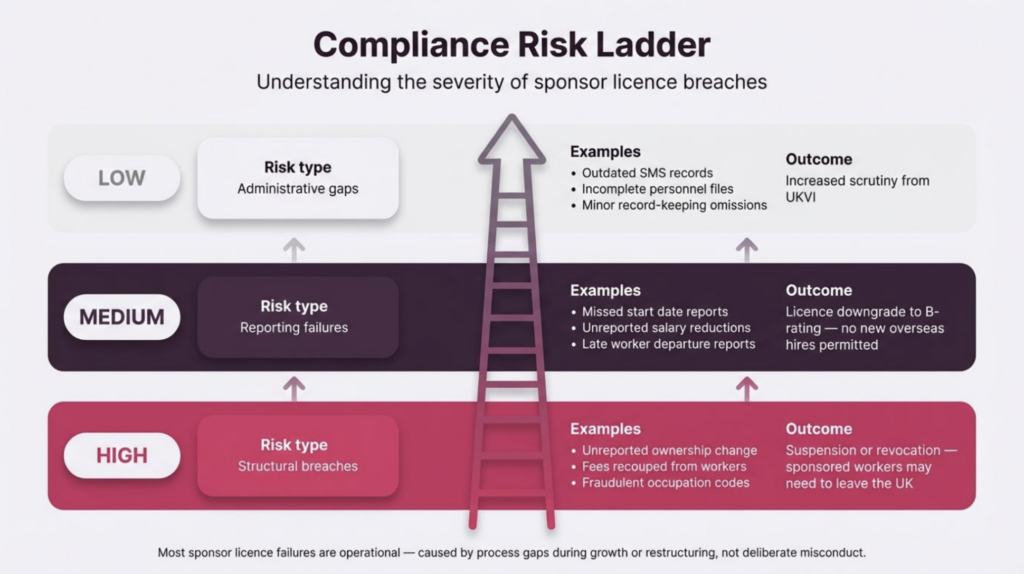
Non-compliance is not handled with a warning and a chance to fix things. The Home Office has a range of enforcement powers and will use them.
The outcome depends on the nature of the breach:
Enforcement actions
Action
What it means
Rating downgrade (A to B)
You are placed on an action plan. You cannot bring in new workers from overseas. You must demonstrate compliance over a set period to regain your A-rating — and there is no guarantee.
Suspension
You cannot assign any new CoS while suspended. Existing workers are not immediately affected, but uncertainty around your licence status creates risk for everyone on it.
Revocation
Your licence is cancelled. Every worker you sponsor has their permission curtailed. They may need to leave the UK. Revocation is very difficult to challenge and very difficult to recover from.
Automatic revocation triggers
Some breaches trigger automatic revocation where the Home Office has no discretion:
Recouping CoS or licence fees from workers
Assigning a CoS for a role that is not genuine
Supplying workers as labour to a third party
Failing to carry out right to work checks
Underpaying workers below the route minimum without a valid exception
Act early If you believe your licence may be at risk, contact Centuro immediately. Early intervention gives you options. Waiting does not.
Key timeframes
Trigger
Deadline
Worker does not start within 28 days of permission being granted
Report within 10 working days of the grace period ending
Worker is absent without explanation or permission
Report within 10 working days
Worker leaves employment
Report within 10 working days
Worker’s role changes significantly
Report within 10 working days
Worker moves to a different location or branch
Report within 10 working days
Worker goes on statutory leave (maternity, paternity, etc.)
Report within 10 working days
New branch addition request (after worker starts there)
Submit within 20 working days
CoS must be used after assignment
Within 3 months
CoS allocation renewal (manual routes)
Up to 3 months before allocation year ends
Common pitfalls
These are the failures we see most often. Most are avoidable.
Start date changes not reported.
If a worker cannot start within 28 days of their permission being granted — even for a perfectly legitimate reason like a notice period — you must still report it. Many sponsors assume a good reason means no report is needed. It does not.
Salary decreases not reported.
Salary increases do not need reporting. Decreases do. From April 2026, the Home Office can check HMRC payroll data directly. They will find it. Report any reduction before it becomes a problem.
Company ownership change not handled correctly. Licences are non-transferable. If your company is acquired, merges, or changes ownership, you cannot simply carry on with the existing licence. A new licence application is required. If this is not handled properly before the change completes, your licence can be revoked and your sponsored workers will lose their right to work. Tell Centuro early if you are going through any structural change.
Key Personnel not updated.
If your AO or a Level 1 User leaves and is not replaced in the SMS, you are operating with a compliance gap. Update the SMS when any Key Personnel changes.
Record-keeping gaps discovered at audit.
If you cannot produce a record during a compliance visit, it is treated as though it does not exist. Build record keeping into your HR processes, not your audit preparation.
Recouping fees from workers.
Any attempt to recover CoS or licence costs from a worker — directly or via salary deduction — results in automatic licence revocation. There are no exceptions.
Leadership actions
Sponsor compliance requires the same structured oversight as any other operational control. These are the actions that prevent failures before they happen.
Treat sponsor compliance as a control framework. Assign ownership, set review cadences, and escalate exceptions — the same as you would for financial or data protection controls. It is not a task that can be delegated informally and forgotten.
Ensure your Key Personnel are active and informed. Your AO and Level 1 Users must be current employees, correctly named in the SMS, and up to date with the latest guidance. An inactive AO is a compliance gap with no grace period.
Implement structured monitoring. Track visa expiry dates, salary alignment with CoS records, and reportable event triggers proactively. Do not rely on individuals to remember deadlines under day-to-day pressure.
Build record-keeping into normal HR processes. Records must be ready to produce at any time, not just assembled in the days before a compliance visit. If you cannot retrieve a record at short notice, it may as well not exist.
Ensure board-level visibility of immigration risk. When your organisation is growing, restructuring, or changing ownership, these are the moments when sponsor obligations are most likely to be missed. Immigration compliance should be part of the conversation, not an afterthought.
Checklist
Get our audit readiness checklist
Are you prepared for a UK Sponsor License audit? Find out with the help of the audit readiness checklist from our legal expert team.
Recent changes
This section reflects significant changes to sponsor obligations and will be updated as guidance changes.
April 2026 — HMRC Data Access
The Home Office now has direct access to HMRC payroll data. Salary compliance will be verified automatically against what is stated on each worker’s CoS. Underpayments will be identified without requiring a complaint or compliance visit.
March 2026 — Job duty changes must be reported
Any change to a sponsored worker’s job duties must now be reported via the SMS, even if the change does not meet the threshold for a formal change of employment application. Do not assume that a minor role adjustment does not need to be reported.
Book your consultation with Centuro Global
Centuro Global helps businesses obtain, audit and maintain their UK Sponsor Licence. We’ve successfully delivered thousands of licences for companies of all sizes, from fast-growing startups to global enterprises. Get in touch to book a call with our team.
This guide is based on UK government guidance current as of April 2026. Immigration rules change regularly. Verify current requirements with Centuro before acting on specific details.
Share:
Company
Team Centuro
Centuro Global is an award-winning AI-powered SaaS platform for global expansion & global mobility, led by human expertise for tailored legal & compliance solutions. Our platform is a one-stop-shop hub for global expansion, providing companies with the tools, knowledge, and expertise to expand globally in any jurisdiction.
Centuro helps employers assess workforce readiness across alternative project locations and schedules. We can review immigration pathways and lead times, identify employment, tax and social security questions requiring specialist input, and coordinate advice through our global team and partners.
The Government has published its response to the Earned Settlement consultation, setting out major changes to how migrants will qualify for Indefinite Leave to Remain (ILR).
Centuro Global has joined The BCD Marketplace as a Visa & Passport Services partner, giving BCD clients access to Centuro’s technology and expert services for managing business travel compliance across 170+ countries.
Centuro Global is an industry-leading platform for legal services
Discover how we can help your team with immigration, business travel and global expansion.
Get clear answers on business travel, immigration or global expansion - and find the right solution for your needs.
What to expect:
Quick review of your goals and challenges
Walkthrough of the features that matter most
Clear next steps, timelines, and pricing
Trusted by businesses in 170+ countries
Manage Consent
To provide the best experiences, we use technologies like cookies to store and/or access device information. Consenting to these technologies will allow us to process data such as browsing behaviour or unique IDs on this site. Not consenting or withdrawing consent, may adversely affect certain features and functions.
Functional
Always active
The technical storage or access is strictly necessary for the legitimate purpose of enabling the use of a specific service explicitly requested by the subscriber or user, or for the sole purpose of carrying out the transmission of a communication over an electronic communications network.
Preferences
The technical storage or access is necessary for the legitimate purpose of storing preferences that are not requested by the subscriber or user.
Statistics
The technical storage or access that is used exclusively for statistical purposes.The technical storage or access that is used exclusively for anonymous statistical purposes. Without a subpoena, voluntary compliance on the part of your Internet Service Provider, or additional records from a third party, information stored or retrieved for this purpose alone cannot usually be used to identify you.
Marketing
The technical storage or access is required to create user profiles to send advertising, or to track the user on a website or across several websites for similar marketing purposes.