Setting Up a European Entity in 2026: What You Actually Need to Know
16 min read •
March 13, 2024
Share:
Home › Articles › Setting Up a European Entity in 2026: What You Actually Need to Know
Updated: 20 May 2026
If you’ve been tasked with expanding your workforce into Europe, you already know the feeling: a regulation changes, a tax framework shifts, and suddenly the playbook you built eighteen months ago needs rewriting. Europe in 2026 is genuinely different – not just incrementally updated, but structurally changed in ways that affect your timelines, your entity choices, and how quickly you can get people on the ground.
Let’s go through what matters.
The regulatory ground has shifted
Four things have changed in Europe that directly affect how you do your job.
First, there’s the EU Inc. framework. The European Commission has introduced an optional digital-first legal form that lets you incorporate in under 48 hours for less than €100, with no minimum share capital. Tax and VAT numbers are automatically issued. If you’ve ever spent three months waiting for a local notary to stamp something, you’ll appreciate what this means. It also introduces EU-wide employee stock option plans that aren’t taxed until shares are actually sold – a meaningful tool when you’re trying to attract talent across borders.
Second, B2B transactions across the EU are now genuinely borderless. The European Business Wallet handles cross-border identity verification instantly, and the Digital Euro is in commercial deployment. For practical purposes, this means your entity registration and banking setup move faster than they used to.
Third, the tax landscape has consolidated. The Pillar Two Global Minimum Tax – a 15% effective corporate tax rate for large multinationals – is now in full force. For most mid-sized operations, the more relevant development is BEFIT: a single EU-wide framework for calculating corporate tax, so you’re not navigating 27 different national tax authorities simultaneously. That said, one rule hasn’t changed: your entity needs genuine economic substance. The Unshell Directive is being enforced seriously now. A registered address and a forwarding service won’t hold up.
Fourth, the EU’s anti-money laundering authority (AMLA) is now fully operational out of Frankfurt. KYC requirements are real, border-crossing, and fast. The upside is that financial transparency makes Europe a more stable place to hold corporate capital. The compliance burden is real, but predictable.
Choosing a country: the variables that matter
Tax incentives, infrastructure, talent, and immigration pathways. These are your four dials.
On tax, Ireland and the Netherlands remain the most competitive for international tech firms, with strong R&D grant programmes. France and Portugal have solid relief schemes for innovative startups. Romania offers meaningfully low rates for micro-enterprises. Belgium and Germany lean toward direct public funding and research exemptions.
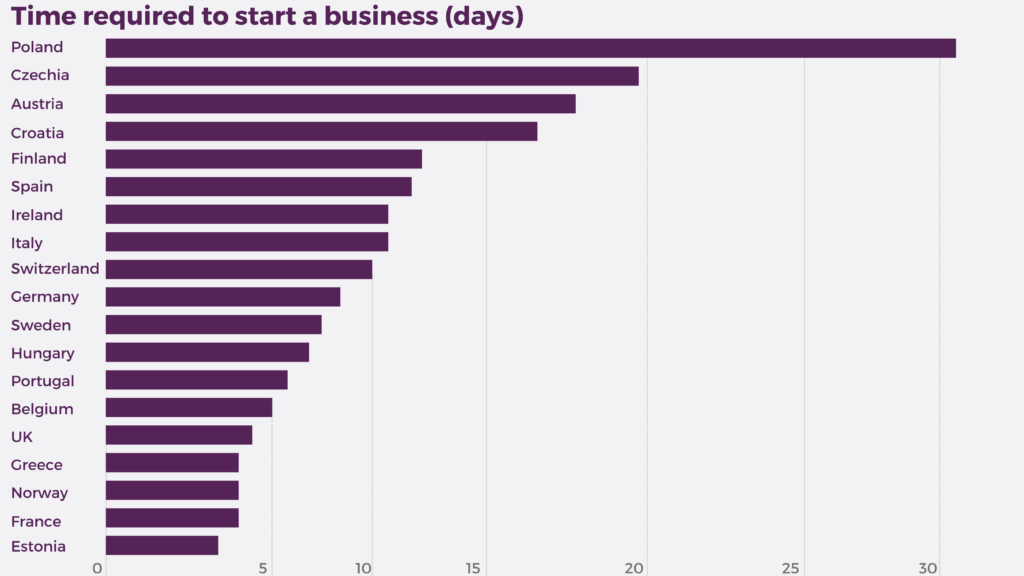
Bar graph showing the number of days required to start a business in various European countries, highlighting Poland as the longest (Data from World Bank, 2019)
On infrastructure, the choice depends on your model. If you’re moving physical goods, the Benelux – particularly the Port of Rotterdam – is the obvious hub. If you’re building a digital-first team, look north: the Nordic countries and Benelux have the highest technology adoption and English-language proficiency in the world.
On talent, the EU Talent Pool is now fully functional as a Union-wide recruitment platform, specifically designed to match EU-registered entities with skilled workers from outside the EU, with a focus on AI, green energy, and STEM roles where shortages are acute. This is worth knowing when you’re building the case for a particular incorporation country.
On immigration: EU, EEA, and Swiss nationals can work and establish businesses freely across member states. Everyone else needs a visa pathway. One practical point worth sharing with leadership: you don’t need a residency permit to register a corporate entity. You can establish the legal structure first, then manage executive relocation separately. That sequencing often matters when you’re working against a deadline.
The structures available to you
Beyond a standard national limited liability company, there are four cross-border structures worth understanding:
The EU Inc. is the new option – zero minimum capital, digital setup, built for agile teams that need to move quickly.
The Societas Europaea (SE) requires €120,000 in capital and an operational presence in at least two EU countries, but it lets you transfer your registered office between member states without dissolution. That’s useful if your regional footprint changes.
The Societas Cooperativa Europaea (SCE) is the cooperative form – €30,000 minimum, requires at least five individuals or entities across two member states. Less common, but relevant for certain workforces or ownership structures.
The European Economic Interest Grouping (EEIG) needs no capital at all and is designed for pooling resources and expertise across borders. The constraint: it can’t have profit generation as its primary purpose.
Thinking regionally
Europe isn’t one market, and experienced global mobility teams know how to think in regional clusters.
DACH (Germany, Austria, Switzerland) has nearly 100 million people with aligned living standards and Europe’s strongest industrial base. Entry costs are higher, but the commercial depth is real.
The Nordics offer exceptional purchasing power and technology adoption. If your business is digital and your talent requirements are specialist, this region is worth a close look.
Benelux is 30 million people in a dense, logistics-optimised corridor with a multilingual, highly skilled workforce. The infrastructure story here is genuinely strong.
The British Isles require a note. Ireland remains your cleanest gateway into the EU single market. The UK is post-Brexit, but the May 2026 TCA review has meaningfully reduced regulatory friction through shared digital trade standards.
For practical purposes, you can treat the UK and EU as close neighbours rather than separate planets, which simplifies dual-entity strategies.
One deadline you cannot miss
If any part of your European operation uses AI in recruitment, credit decisions, HR systems, or critical infrastructure, the EU AI Act’s August 2, 2026, enforcement deadline applies to you. High-risk AI systems must meet verified standards for transparency, data quality, and human oversight before going to market.
Looking ahead, 2027 will tie corporate valuations and VC investment directly to compliance documentation. If you’re advising senior leadership on European expansion right now, this belongs in that conversation. The EU has introduced regulatory sandboxes for startups testing AI models under supervision – a useful option if you’re uncertain about your compliance position before launch.
The bottom line
The mechanics of European expansion have improved significantly. The EU Inc. framework removes the friction that used to cost months. BEFIT simplifies your tax picture. The Talent Pool gives you a structured route to international hiring. But substance requirements are real, AMLA oversight is serious, and the AI Act timeline is fixed.
Get your jurisdiction choice right early. The entity structure follows from that. And if you’re coordinating both entity registration and executive relocation – which most of us are – sequence them deliberately. The legal entity can come first.
Our immigration teams work end-to-end on cross-border expansion: entity registration, compliant corporate banking, and operational setup. Contact us to schedule a consultation.
Share:
Content Marketing Manager
Alex Schulte
Alex focuses on insights for global mobility, using his 8+ years of analysis experience to help educate the market with clear, practical content.
Centuro Global is proud to announce that we have won the ‘Best Business Travel Management’ award at the Forum for Expatriate Management’s (FEM) Americas Expatriate Management & Mobility Awards 2026 (EMMAs).
A guide for Authorising Officers, HR managers, and anyone responsible for managing a UK Sponsor License. This guide gives you a working understanding of your obligations as a sponsor licence holder, outlining the key duties you must follow and the consequences of non-compliance to ensure you maintain your licence.
The European Union’s new digital border control system, the Entry/Exit System (EES), is now fully operational across all Schengen Area borders as of 10 April 2026. This is a significant change in how British citizens and other non-EU nationals will enter and exit the Schengen Area, with major implications for business travel, compliance and border processes.
Centuro Global is an industry-leading platform for legal services
Discover how we can help your team with immigration, business travel and global expansion.
Get clear answers on business travel, immigration or global expansion - and find the right solution for your needs.
What to expect:
Quick review of your goals and challenges
Walkthrough of the features that matter most
Clear next steps, timelines, and pricing
Trusted by businesses in 170+ countries
Manage Cookie Consent
We use technologies like cookies to store and/or access device information. We do this to improve browsing experience and to show (non-) personalised ads. Consenting to these technologies will allow us to process data such as browsing behaviour or unique IDs on this site. Not consenting or withdrawing consent, may adversely affect certain features and functions.
Functional
Always active
The technical storage or access is strictly necessary for the legitimate purpose of enabling the use of a specific service explicitly requested by the subscriber or user, or for the sole purpose of carrying out the transmission of a communication over an electronic communications network.
Preferences
The technical storage or access is necessary for the legitimate purpose of storing preferences that are not requested by the subscriber or user.
Statistics
The technical storage or access that is used exclusively for statistical purposes.The technical storage or access that is used exclusively for anonymous statistical purposes. Without a subpoena, voluntary compliance on the part of your Internet Service Provider, or additional records from a third party, information stored or retrieved for this purpose alone cannot usually be used to identify you.
Marketing
The technical storage or access is required to create user profiles to send advertising, or to track the user on a website or across several websites for similar marketing purposes.