China’s K Visa: The New Route for STEM Professionals in 2026
13 min read •
January 28, 2026
Share:
Home › Articles › China’s K Visa: The New Route for STEM Professionals in 2026
China’s new K visa, announced in 2025, has the potential to upend all the old assumptions of talent mobility.
TL:DR
China’s K visa, launched in October 2025, is an uncapped, sponsorship-free work visa targeting STEM professionals.
It directly rivals the US H-1B visa, which now carries a $100,000 application fee that prices out mid-tier tech talent.
The K visa allows visa holders to work freely, switch employers and start companies, while receiving financial incentives like grants and tax breaks.
This bifurcates the talent map: America focuses on elite researchers (top 1%), while China positions itself to capture the much larger pool of capable mid-tier engineers and developers.
Global Mobility professionals should start segmenting workforces differently, routing junior staff to Chinese hubs while reserving expensive US slots for senior architects.
The visa heralds a fracturing of traditional tech talent migration patterns. Companies must rethink their cross-border strategies.
What is the China K visa?
The K visa is China’s newly established work authorisation specifically designed for international STEM professionals.
Launched in October 2025, it represents a departure from China’s previous work permit systems, which were largely employer-driven and bureaucratically complex.
Core Features and Eligibility
The K visa is a work permit that allows qualified foreign nationals to live and work in mainland China. But several features distinguish it from both China’s older visa categories and work permits in other countries:
Self-sponsored entry
Unlike China’s previous Z visa (work visa), which required a job offer and employer sponsorship before entry, the K visa allows professionals to enter China first and seek employment afterwards.
Young professional focus
While specific age requirements haven’t yet been widely published, the program clearly targets early-to-mid-career professionals rather than senior executives or retirees. Think of professionals in their 20s and 30s with relevant degrees and a few years of industry experience.
STEM-specific
The visa explicitly serves the science, technology, engineering, and mathematics fields. Priority areas include:
Software engineering and development
Artificial intelligence and machine learning
Robotics and automation
Data science and analytics
Advanced manufacturing and industrial engineering
Semiconductor design and electrical engineering
R&D-friendly
Beyond commercial tech roles, the K visa welcomes researchers working on applied science projects, particularly those with commercial applications or industrial relevance.
Full K Visa Guide
Understand the K visa in full
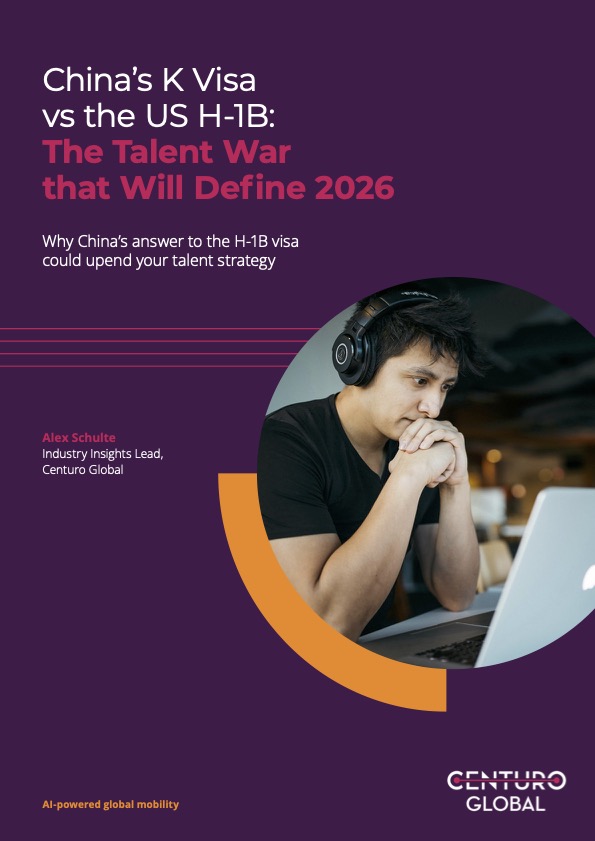
China’s K Visa vs the US H-1B: The Talent War that Will Define 2026
By submitting this form, you agree that your details may be used to respond to your enquiry and to send you marketing communications from Centuro Global. You can update your preferences or unsubscribe at any time via our Preference Centre. See our Privacy Policy for more information.
What makes the K visa different
The K visa’s structure diverges from traditional work authorisations in ways that make it uniquely flexible:
Employment flexibility
Once you have a K visa, you’re not locked to a single employer. You can change jobs, work for multiple companies simultaneously, or freelance, all without risking your immigration status. This is a significant departure from sponsored work visas, where changing employers can mean restarting the entire visa process.
Entrepreneurship pathway
K visa holders can register and operate their own businesses in China. This includes everything from solo consulting practices to venture-backed startups. Access to China’s mature venture capital ecosystem and enormous consumer market will make this a particularly attractive perk for founders and entrepreneurs.
No annual quotas
Unlike capped programs like the US H-1B, China hasn’t imposed numerical restrictions on K visa issuance. In theory, a million qualified applicants could receive approval in a single year if they all met the criteria.
Government incentives
Many Chinese cities and provinces are offering enticing packages to K visa holders, including:
Cash grants for relocation expenses
Subsidised housing or rent allowances
Preferential tax rates for the first several years
Access to special talent zones with additional benefits
Fast-tracked pathways to permanent residence for those who stay long-term
How the K visa compares to other Chinese visa categories
China’s visa system has traditionally been complex, with different categories serving different purposes. Here’s how the K visa fits in:
Z visa (work visa)
The traditional employment route. Requires a job offer, employer sponsorship and work permit approval before entry.
More bureaucratic and employer-dependent than the K visa.
R visa (high-level talent)
Reserved for truly exceptional individuals – think distinguished professors, Nobel laureates or major CEOs.
More prestigious but far more restrictive in who qualifies.
Student and post-study work visas
Allow study and limited work rights
Don’t provide the full employment flexibility or entrepreneurship rights of the K visa
The K visa falls somewhere in the middle. It’s more accessible than elite talent programs, more flexible than traditional work permits, and specifically calibrated to attract mid-tier professionals rather than either students or senior executives.
K visa application process and requirements
The specific application process for the K visa is still in development. But the general framework involves:
Educational credentials
Typically, a bachelor’s degree or higher in a STEM field from a recognised institution. Advanced degrees (master’s, PhD) likely strengthen applications.
Professional experience
While not officially specified, the program appears to target professionals with at least 1-3 years of relevant industry experience. Exceptional recent graduates may still qualify.
Clean background
Standard requirements include no serious criminal record, good health status, and sufficient financial means to support yourself during the initial job search period.
Application submission
Unlike traditional employer-sponsored visas, individuals can apply directly through Chinese consulates or embassies. The exact process varies by location.
Duration and Renewal
Initial K visas are typically granted for multiple years (exact duration varies, but typically two to three years), with straightforward renewal processes for those maintaining employment in eligible fields.
Long-term holders may eventually qualify for permanent residence, though specific pathways are still being clarified as the program is new.
What the K visa doesn’t cover
It’s worth noting some of the new visa’s limitations:
Geographic restrictions: The K visa is valid only for mainland China. It doesn’t grant access to Hong Kong or Macau, which maintain separate immigration systems.
Family members: While dependents can typically join K visa holders, they would need separate visas and may face work restrictions unless they qualify for their own K visas.
Non-STEM fields: If you work in finance, marketing, operations or other non-technical fields, the K visa may not be the the right pathway, regardless of your skills or experience.
How the K visa relates to changes in US immigration policy
To understand the true significance of the K visa, it’s important to understand what’s happening with American work visas.
The H-1B fee increase
In September 2025, the Trump administration added a $100,000fee to new H-1B visa applications due to concerns about systemic abuse. The practical effect is straightforward: most companies won’t pay six figures to hire anyone below senior level.
Consider the maths. A talented developer from Mumbai with three years of experience might command a $90,000 salary in the US. Adding a $100,000 visa fee means the first-year cost exceeds $190,000 before benefits, equipment, or management overhead. For most positions, that return on investment simply doesn’t work.
The fee effectively reserves the H-1B pathway for a narrow slice of applicants: distinguished researchers, specialised architects working on core IP, and senior technical leaders whose contributions clearly justify the investment.
The 75-country visa processing pause
Since the H-1B fee hike, the US policy environment has become yet more hostile for junior foreign talent. On January 14 2026, the State Department announced an indefinite pause to immigrant visa processing for nationals of 75 countries, effective January 21.
The pause affects countries whose nationals the administration thinks are disproportionately likely to rely on public benefits, including major tech talent sources such as Brazil, Colombia, Egypt, Nigeria, Bangladesh, Ethiopia, and the Philippines. The freeze applies only to immigrant visas processed at US consulates abroad, not to nonimmigrant work visas like H-1B, F-1 student visas, or J-1 exchange visas.
For STEM professionals from affected countries, this creates a two-pronged barrier to American opportunities:
Short-term barrier: The $100,000 H-1B fee makes temporary work authorisation economically unviable for most positions
Long-term barrier: The immigrant visa freeze blocks the eventual path to permanent residence that many skilled workers pursue after years on temporary work visas
The practical effect is clear: skilled professionals from three-quarters of the world’s countries now face either prohibitive costs or complete ineligibility when pursuing American opportunities. Even those who can afford the H-1B fee face uncertainty about whether they can ever transition to permanent residence.
This may be the most decisive factor pushing tech talent from the developing world into China’s arms.
China’s counter-move
This is where the K visa becomes strategically interesting.
China isn’t trying to poach Silicon Valley’s established workforce. American salaries and ecosystem advantages are too strong. Nor is China likely to attract the absolute top tier of global researchers, who still gravitate toward US institutions and compensation packages.
Instead, China is positioning itself as the logical alternative for the vast middle: competent, ambitious professionals with solid skills, but who are no longer viable – or eligible – to hire in the USA. We’re talking about thousands of engineers from countries such as India, Vietnam, the Philippines, Poland and beyond.
These staff have the capability to contribute meaningfully to advanced tech companies. They just don’t fit the narrow “exceptional talent” category.
China K visa vs US H-1B: the strategic logic
Both nations are racing to build dominant AI capabilities, but they’re pursuing different models.
American AI development
US companies invested over $109 billion in AI during 2025, primarily through venture funding and corporate R&D budgets. American strength lies in foundational technology: the chip designs that power machine learning, the large language models that drive generative AI, and the cloud infrastructure that supports it all.
But deployment lags behind. Only about one-third of American businesses have moved AI beyond pilot projects, with most applications limited to using tools like ChatGPT for content creation and administrative tasks.
Chinese AI deployment
China’s approach differs markedly. With $98 billion in AI investment (though more heavily state-directed), Chinese companies lead in getting AI systems into production environments. More than half of Chinese businesses actively use AI, predominantly through robotics and industrial automation in manufacturing settings.
The distinction matters: America builds cutting-edge algorithms; China builds the systems that put those algorithms to work in factories, warehouses, and supply chains at massive scale.
China’s leadership recognises that this deployment advantage requires substantial engineering capacity. This requires more than just brilliant researchers. It takes large teams of capable implementers who can adapt, integrate, and scale AI systems across the real economy.
That’s exactly what the K visa is designed to deliver.
Who benefits most from the K visa?
The K visa will suit a broad swath of non-elite professionals.
Mid-tier engineers
If you have two-to-seven years of professional experience in software engineering, data science, or systems architecture, you’re in a sweet spot. You’re past the junior stage but not yet expensive enough to justify H-1B fees.
Chinese tech giants like Tencent, Alibaba, ByteDance, and Baidu are actively hiring at this level and offer competitive compensation.
Specialists in physical AI applications
China’s advantage in deploying AI into robotics, manufacturing automation, and logistics creates unique opportunities. If your expertise lies in making AI work in physical environments rather than purely digital products, China’s operational scale offers unmatched experience.
Founders and early-stage entrepreneurs
The K visa allows holders to start their own companies immediately, setting it apart from most work authorisation schemes. China’s venture ecosystem has matured considerably, with substantial capital available for the right opportunities. Founders who understand both technology and emerging markets may find China’s combination of capital, manufacturing capacity, and market size compelling.
Applied research scientists
While pure academic researchers may still prefer American universities, those focused on taking algorithms from papers to production will find China’s emphasis on practical implementation attractive. Chinese companies prioritise shipping working products quickly over perfecting theoretical elegance.
What China’s K visa means for corporate Global Mobility
This strategic bifurcation between American and Chinese visa policies creates real complications for Global Mobility professionals at multinational companies. But it also comes with undeniable opportunities for organisations with a Chinese presence.
For companies that operate in China:
Organisations with existing Chinese subsidiaries or joint ventures have a significant advantage. The K visa enables them to staff Chinese operations with international talent at scale without sponsorship complexity or cost.
🧩 Segment your workforce. Route your analysts, engineers and senior engineers to Chinese locations where they can work on deployment, localisation, and scaling challenges. Reserve your limited, expensive H-1B capacity for principal engineers and distinguished researchers working on proprietary algorithms and core IP in the US.
This approach requires careful communication. Some employees may have hoped for American opportunities and will need frank conversations about the new economics. Others may be perfectly happy with Chinese placement, especially given the financial incentives and career development opportunities.
💪 Compliance vigilance is essential: US authorities watch carefully for technology transfer to China, particularly in sensitive areas. Companies must establish clear boundaries between US and Chinese operations, avoid dual-use research with potential military applications, and document that knowledge flows remain appropriate.
For companies without Chinese operations:
Organisations concentrated in the US, Europe or other markets face a more challenging situation. The H-1B fee increase and visa processing pause have already constricted familiar talent pipelines. Now, the K visa may trigger a retention crisis by drawing workers away from global capability centres in the developing world.
🔁 Focus on retention: If you operate technical centres in India, Southeast Asia, Latin America, or Eastern Europe, expect increased competition for your teams. Counter this through improved compensation, clearer advancement paths, more interesting project assignments, and professional development investments.
🎓 Exploit the student pathway: The H-1B fee doesn’t apply to Change of Status applications, which convert international students already studying in the US to work authorisation. The cost difference is stark: roughly $5,000 instead of $105,000. Companies should intensify recruitment at universities with strong international student populations and build conversion pipelines.
🔧 Offer domestic apprenticeships: The US government has allocated $84 million toward expanding apprenticeship programs, reflecting a “hire American” priority. Building or joining apprenticeship initiatives serves dual purposes: creating sustainable talent pipelines while demonstrating alignment with government priorities.
The broader geopolitical context
Visa policy has become a tool of technological competition between superpowers.
The US approach reflects its confidence in its position at the technological frontier. By restricting access to all but elite talent, America is essentially saying: we’ll take the top 1% of global researchers and let everyone else go elsewhere. This works if maintaining the cutting edge matters more than scaling deployment.
China’s approach reflects different priorities. Rather than competing head-to-head for Nobel-calibre researchers, China wants volume: hundreds of capable engineers who can implement, adapt, and scale AI systems across its enormous economy.
As one venture capitalist put it, “American companies optimise for perfection while Chinese companies optimise for diffusion” – getting workable solutions deployed rapidly.
Neither approach is obviously superior. They reflect different theories about how to win in AI: breakthrough innovation versus comprehensive deployment.
Key takeaways for decision-makers
The K visa is genuinely uncapped, unlike most work authorisation programs that impose annual limits. This means China can scale intake based on demand rather than artificial constraints.
Sponsorship independence fundamentally changes the power dynamic between workers and employers. Unlike H-1B holders, whose visa status depends on their current job, K visa holders can switch employers or start companies freely.
Financial incentives matter more than many realise. Housing subsidies and tax breaks can meaningfully offset salary differences, especially for workers from countries where these benefits are unusual.
Companies with multinational footprints have more options than those concentrated in single markets. The ability to deploy talent strategically across jurisdictions becomes increasingly valuable.
Retention strategies need immediate attention in key markets like India and Southeast Asia, where workers now face a clearer alternative path to career advancement.
The US student conversion pathway remains viable and cost-effective for companies seeking junior-to-mid-level talent in their American operations.
Get the full strategic picture
The K visa’s full ramifications will take some time to become apparent. But businesses need to start planning for them now.
Centuro Global is proud to announce that we have won the ‘Best Business Travel Management’ award at the Forum for Expatriate Management’s (FEM) Americas Expatriate Management & Mobility Awards 2026 (EMMAs).
A guide for Authorising Officers, HR managers, and anyone responsible for managing a UK Sponsor License. This guide gives you a working understanding of your obligations as a sponsor licence holder, outlining the key duties you must follow and the consequences of non-compliance to ensure you maintain your licence.
The European Union’s new digital border control system, the Entry/Exit System (EES), is now fully operational across all Schengen Area borders as of 10 April 2026. This is a significant change in how British citizens and other non-EU nationals will enter and exit the Schengen Area, with major implications for business travel, compliance and border processes.
Centuro Global is an industry-leading platform for legal services
Discover how we can help your team with immigration, business travel and global expansion.
Get clear answers on business travel, immigration or global expansion - and find the right solution for your needs.
What to expect:
Quick review of your goals and challenges
Walkthrough of the features that matter most
Clear next steps, timelines, and pricing
Trusted by businesses in 170+ countries
Manage Cookie Consent
We use technologies like cookies to store and/or access device information. We do this to improve browsing experience and to show (non-) personalised ads. Consenting to these technologies will allow us to process data such as browsing behaviour or unique IDs on this site. Not consenting or withdrawing consent, may adversely affect certain features and functions.
Functional
Always active
The technical storage or access is strictly necessary for the legitimate purpose of enabling the use of a specific service explicitly requested by the subscriber or user, or for the sole purpose of carrying out the transmission of a communication over an electronic communications network.
Preferences
The technical storage or access is necessary for the legitimate purpose of storing preferences that are not requested by the subscriber or user.
Statistics
The technical storage or access that is used exclusively for statistical purposes.The technical storage or access that is used exclusively for anonymous statistical purposes. Without a subpoena, voluntary compliance on the part of your Internet Service Provider, or additional records from a third party, information stored or retrieved for this purpose alone cannot usually be used to identify you.
Marketing
The technical storage or access is required to create user profiles to send advertising, or to track the user on a website or across several websites for similar marketing purposes.