How to use this guide
This guide gives you a working understanding of your obligations as a sponsor licence holder, outlining the key duties you must follow and the consequences of non-compliance to ensure you maintain your licence.
The Home Office now requires every Authorising Officer and Level 1 User named on a licence to demonstrate they have read the official guidance. Use the Guidance Reading Log (available separately) to record when each named person has read each document, and keep it on file.
This guide covers the standard Skilled Worker and Senior/Specialist Worker routes. If you are managing multiple GBM routes, TUPE transfers, or unusual employment arrangements, speak to Centuro before acting.
Get the PDF version of this guide
Download the full guide as a PDF for easy sharing and offline access.

By submitting this form, you agree that your details may be used to respond to your enquiry and to send you marketing communications from Centuro Global. You can update your preferences or unsubscribe at any time via our Preference Centre. See our Privacy Policy for more information.
What holding a Sponsor Licence means
When the Home Office grants you a sponsor licence, they are giving you permission to bring overseas workers into the UK. In return, you take on legal responsibility for every worker you sponsor. That means you are accountable for paying them correctly, monitoring their compliance, and reporting changes for the full duration of their permission.
The Home Office does not wait for things to go wrong before checking up. They conduct announced and unannounced compliance visits, and they now have direct access to HMRC payroll data. Non-compliance has real consequences for your workers and your business.
Licence rating
| Rating | What it means in practice |
|---|---|
| A-rated | Full sponsorship rights. You can bring in new workers from overseas, employ from inside the country, and extend existing permissions. |
| B-rated (Probationary) | Restricted. You can only extend workers already in the UK on the same route. You cannot bring in anyone new. You will be placed on an action plan. |
Falling to B-rated is serious. Getting back to A-rated requires demonstrating sustained compliance over time, and there is no guarantee.
Key personnel
| Role | Who it should be | What they are responsible for |
|---|---|---|
| Authorising Officer (AO) | A senior, permanent employee — typically a director or senior HR lead. Cannot be a third-party agent. | Takes legal responsibility for the licence. Signs off on sponsorship decisions. |
| Key Contact | Can be the same person as the AO. | Primary point of contact with the Home Office. |
| Level 1 User | HR or operations staff with day-to-day SMS access. | Assigns CoS, submits reports, manages worker records in SMS. |
If your AO or a Level 1 User leaves, you must update the SMS promptly. A licence with an absent or inactive AO is a compliance risk. There is no grace period.
Sponsor compliance as a business risk
Holding a sponsor licence goes way beyond being an administrative obligation — it’s an active business risk that requires structured oversight.
The Home Office has significantly expanded its enforcement capability. From April 2026, it has direct access to HMRC payroll data: salary discrepancies are identified automatically, without a complaint or a compliance visit being required. Compliance visits can be announced or unannounced, and inspectors review your entire workforce, not just sponsored workers.
The consequences of getting this wrong extend well beyond a regulatory penalty. A licence downgrade freezes your ability to hire internationally. Revocation means every sponsored worker loses their right to work in the UK and may need to leave. The Home Office publishes revocations publicly on a register that prospective employees, clients, and partners can view.
Sponsor compliance belongs in the same category as financial controls and data protection. It is a structured operational risk, not a task delegated to HR and forgotten.
Business impact of non-compliance
| Outcome | Business impact |
|---|---|
| B-rating (downgrade) | No new overseas hires. International recruitment pipeline frozen. Action plan required. No guarantee of returning to A-rating. |
| Suspension | No new CoS can be assigned. Uncertainty for all workers currently on your licence. |
| Revocation | All sponsored workers lose their right to work in the UK. Workers may need to leave. Immediate and severe talent disruption. |
| Civil penalty (right to work failure) | Up to £60,000 per worker found to be working without the right to do so. |
| Public register | Revocations are published by the Home Office — visible to candidates, clients, and partners. |
Managing your licence
Keeping your SMS up to date
Your SMS records must reflect reality at all times. This includes:
- Contact details for all Key Personnel
- Your registered business address
- Any branches where sponsored workers are based
- Details of any changes to your organisation
When someone in a Key Personnel role leaves or changes, update the SMS and appoint a replacement.
Reading requirements for Officers and Level 1 Users
The Home Office now requires every Authorising Officer and Level 1 User named on a sponsor licence to demonstrate that they have read the official sponsor guidance. During a compliance visit, UKVI may ask for evidence that your named users have done so.
Download our free Reading Log template
Use this template to stay compliant with the Home Office's new reading requirements.

By submitting this form, you agree that your details may be used to respond to your enquiry and to send you marketing communications from Centuro Global. You can update your preferences or unsubscribe at any time via our Preference Centre. See our Privacy Policy for more information.
Official Sponsor Guidance links
- Workers and Temporary Workers: sponsor a skilled worker
- Workers and Temporary Workers: guidance for sponsors part 2: sponsor a worker
- Workers and Temporary Workers: guidance for sponsors Part 3: Sponsor duties and compliance
- Workers and Temporary Workers: sponsor a Global Business Mobility worker
- Workers and Temporary Workers: guidance for sponsors — Appendix D: record-keeping duties
When your company structure changes
This is one of the most commonly missed obligations — and one of the most serious.
Sponsor licences are not transferable. If your company goes through any of the following, you must notify the Home Office — in most cases, a new licence application will be required:
- Change of ownership (including private equity or management buyout)
- Merger or acquisition
- TUPE transfer where the employing entity changes
- Significant change in shareholding structure
If the Home Office discovers a change was not reported, they can revoke your licence. Every worker you sponsor would lose their right to work and their visas would be curtailed. If you are going through or planning any structural change, contact Centuro before it completes.
CoS allocation
Your Undefined CoS allocation renews each year. For most routes this renewal is automatic, at the same level as the previous year, provided you hold an A-rating and have an active allocation.
For some routes (Seasonal Worker, Service Supplier, Secondment Worker, UK Expansion Worker), renewal is not automatic. You must submit a manual renewal request up to three months before your allocation year ends. Unused CoS do not carry over.
Sponsoring a new worker
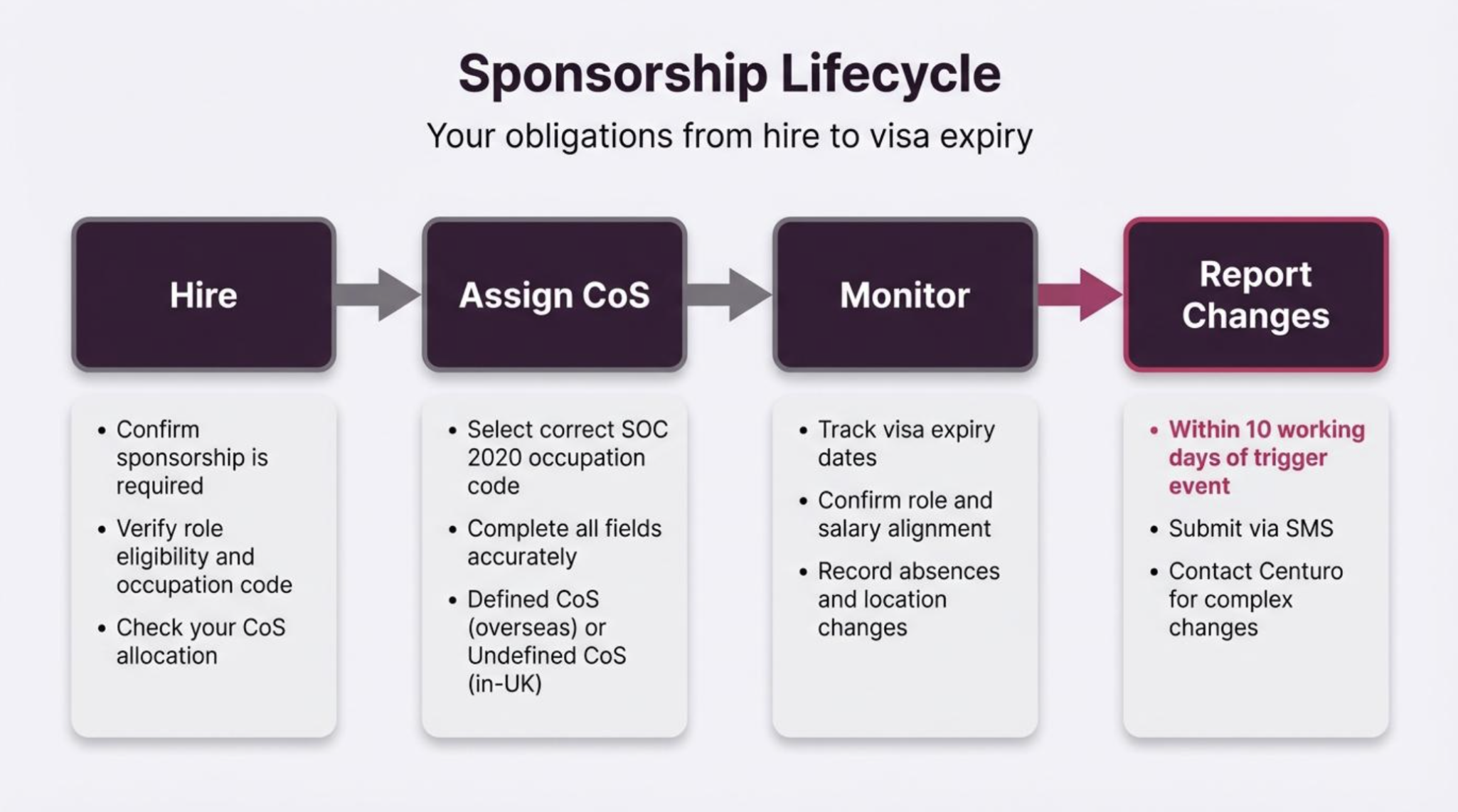
Who needs sponsoring?
You do not need to sponsor anyone who already has the right to work in the UK without restrictions. This broadly includes:
- British and Irish citizens
- People with Indefinite Leave to Remain (ILR) or EU Settled Status
- People with the right of abode
Everyone else will generally require sponsorship. When in doubt, check — don’t just assume. You can always get help from Centuro Global by requesting a right-to-work assessment.
The Certificate of Sponsorship (CoS)
The CoS is not a physical document. It is a unique reference number you generate in the SMS and assign to a specific worker. The worker uses it to apply for their visa. Without it, they cannot apply.
| Type | When it applies |
|---|---|
| Defined CoS | Worker is applying from outside the UK (Skilled Worker only). Must be individually approved by the Home Office before you assign it. |
| Undefined CoS | All other cases — including in-UK extensions and switches. Drawn from your annual allocation. |
What must go on a CoS
You are legally responsible for the accuracy of every field. The CoS must include:
- The worker’s personal details (name, nationality, date of birth, passport)
- The occupation code (SOC 2020, 4-digit)
- A job description that accurately reflects the actual duties
- The work address or addresses
- Average weekly hours
- Start and end date
- Salary
If you make a significant error such as putting in the wrong occupation code or incorrect details across more than one field, you will need to withdraw the CoS and issue a new one. The worker’s application cannot proceed on a flawed CoS.
Occupation codes
Every CoS requires the correct Standard Occupational Classification (SOC 2020) code for the role. This matters because:
- The code determines the minimum salary (going rate) the worker must be paid
- An incorrect code can delay or refuse a visa
- Using a code that does not reflect the actual role to avoid a higher salary requirement is treated as fraud and will result in licence revocation
The Home Office will not help you choose a code. You are responsible for getting it right.
The start date rule
Once a worker’s visa is granted, they must start within 28 days of the latest of:
- The start date on their CoS
- The ‘valid from’ date on their eVisa
- Notification that their permission has been granted
If a worker cannot start within 28 days, even for a legitimate reason like a notice period, you must still report it to the Home Office within 10 working days of the deadline passing. Provide the new start date and the reason. Do not overlook this.
Fees
You pay the CoS fee. You also pay the sponsor licence fee. You cannot ask workers to reimburse these costs, directly or indirectly. This applies to Skilled Workers since December 2024. Recouping costs from workers in any form results in automatic licence revocation.
Once someone is on your licence
Sponsoring someone is not a one-time event. You have ongoing obligations for the full duration of their permission. Your ongoing obligations fall into three areas: reporting, record-keeping, and monitoring.
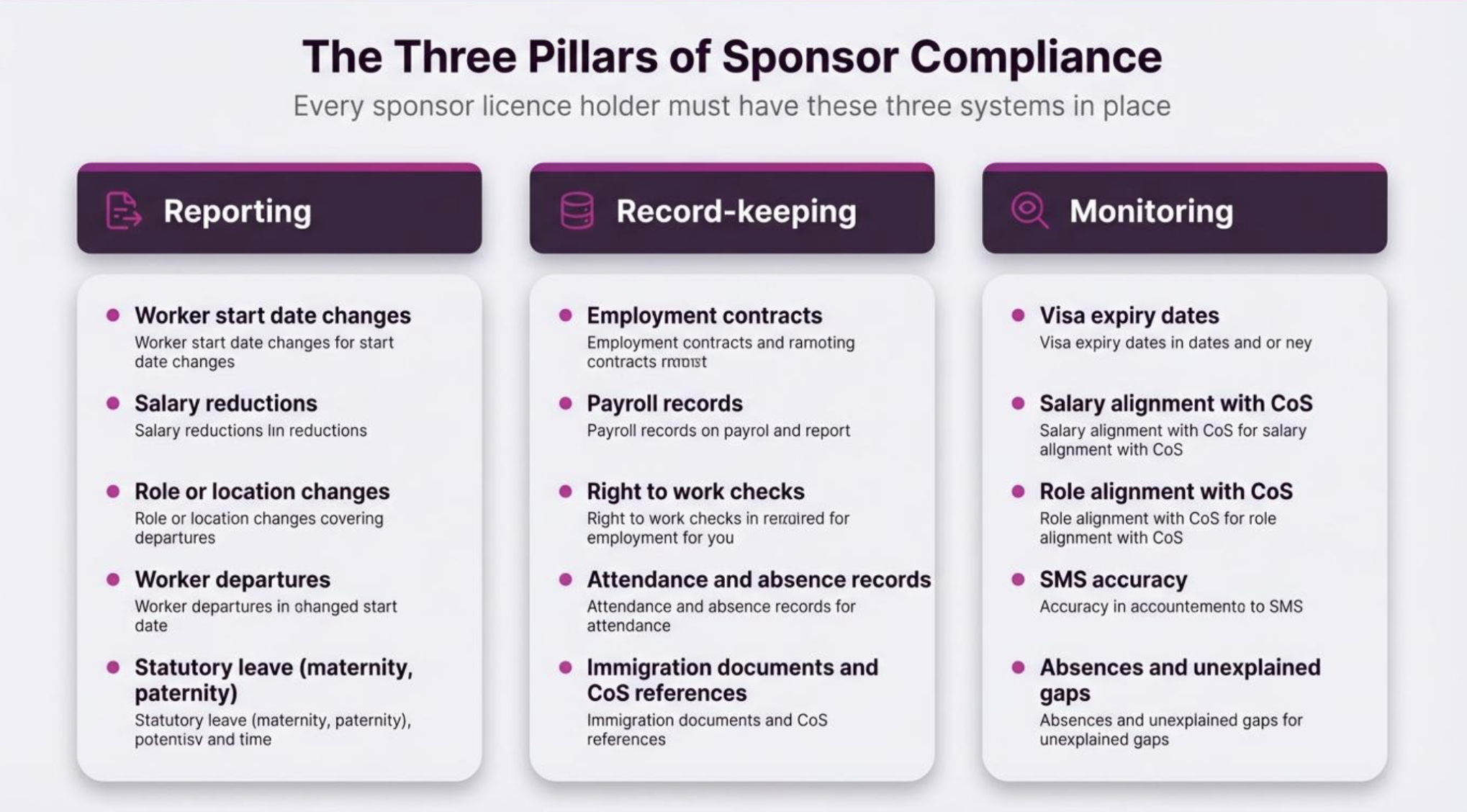
What to monitor
- Attendance: track working days and flag unexplained absences promptly.
- Visa expiry: know when each sponsored worker’s permission expires.
- Role alignment: the worker must only perform the duties described on their CoS. If the role changes meaningfully, this must be reported.
- Salary: pay what is stated on the CoS. Do not reduce it without reporting.
Salary changes
Salary increases do not need to be reported to the Home Office.
Any reduction that brings a worker’s pay below what is stated on their CoS — including temporary reductions for any reason — must be reported. From April 2026, the Home Office has direct access to HMRC payroll data and will identify discrepancies automatically. If they find a worker is being paid less than their CoS states, the worker’s permission may be cancelled and your licence will be at risk.
What you must report
The following must be reported via the SMS, in most cases within 10 working days:
- A sponsored worker does not start work after their visa is granted (after the 28-day grace period)
- A worker is absent from work without explanation or permission
- A worker leaves your employment, for any reason
- A worker’s role changes from what is on their CoS
- A worker moves to a different work location or branch
- A worker goes on maternity, paternity, or other statutory leave
- A significant change to the worker’s circumstances
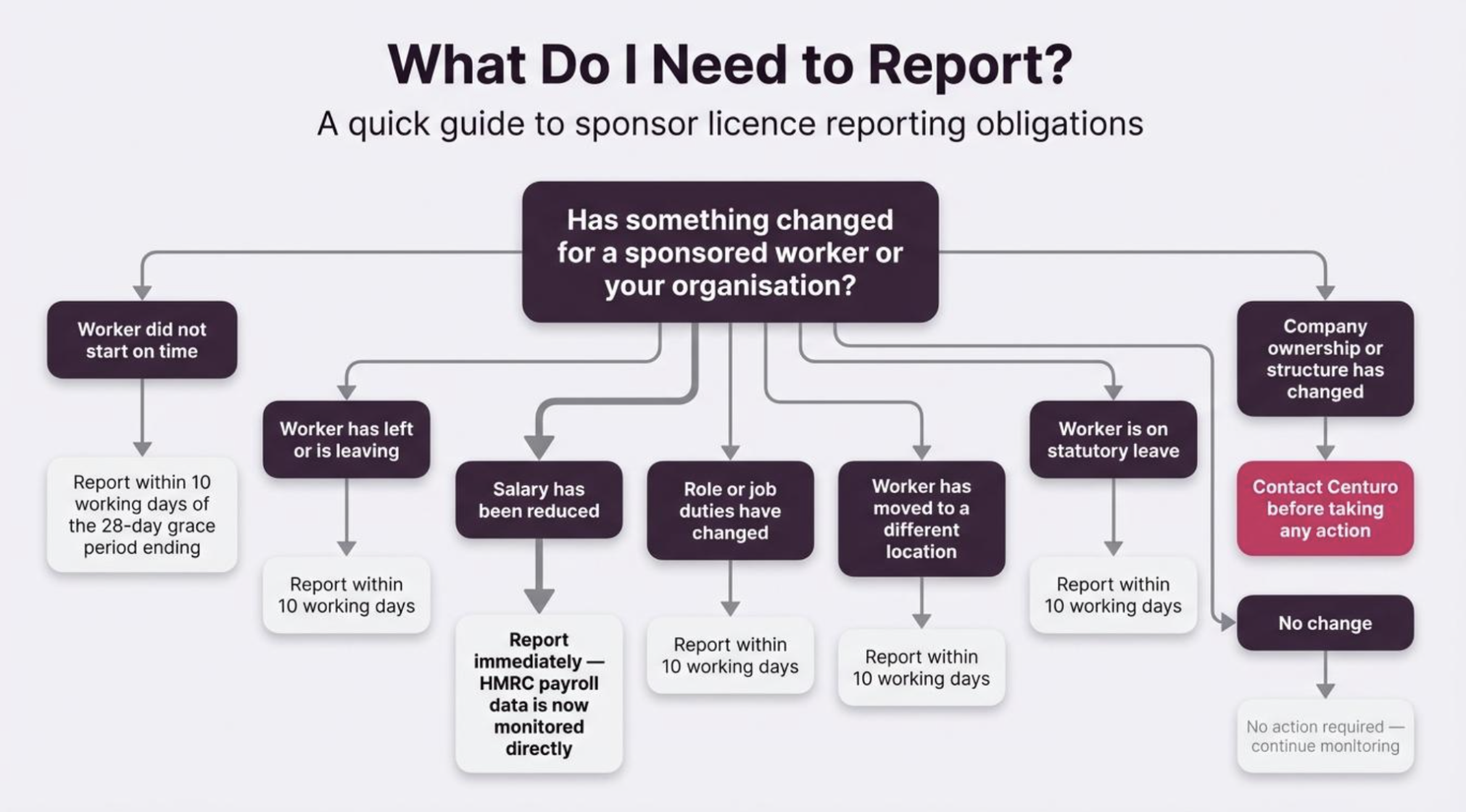
Do not assume that if a situation is reasonable, you do not need to report it. The obligation to report and the acceptability of the underlying situation are separate questions. When in doubt, report it.
Right to work re-checks
For workers on time-limited permission, you must carry out a repeat right to work check before their permission expires. If you do not, you lose the legal protection that a right to work check provides and may be liable for a civil penalty.
Record keeping
Your records are your evidence. If UKVI asks to see something during a compliance visit and you cannot produce it, they will treat that as non-compliance — even if you were compliant in practice.
| Record | What to retain | How long |
|---|---|---|
| Right to work checks | Copy of documents checked; date of check; method used | Sponsorship duration + 2 years |
| Employment contract | Signed contract and any amendments | Duration of sponsorship, plus 1 year after — or until a compliance officer approves them, if earlier |
| Payroll records | Payslips, salary records, tax documentation | As above |
| Attendance and absence | Timesheets, holiday, sick leave, unpaid leave | As above |
| Contact details | Current address, phone, emergency contact | As above |
| Overseas absences | Dates and periods outside the UK | As above |
| Immigration documents | Visa copy, CoS reference, UKVI correspondence | Sponsorship duration + 2 years |
| Officer & Level 1 User Reading Log | Evidence all Officers & Level 1 Users have read the government guidance | As long as you have an active sponsor licence |
Records can be held digitally or in physical files — either is acceptable provided they are secure, GDPR-compliant, and readily retrievable. You should be able to produce any record at short notice. Build record keeping into your normal HR processes from day one.
Right to work checks
You must verify that every person you employ has the right to work in the UK before they start work. This applies to everyone, including people who appear to be British nationals.
How it works:
- For most overseas nationals with a visa: the worker generates a share code via the Home Office online service, which you check at gov.uk/view-right-to-work
- For British, Irish, and settled workers: you check physical or digital identity documents
- The check must be carried out by an HR professional within your business
- If a worker is seconded to a third party, that third party must carry out their own right to work check as well
A completed right to work check gives you a statutory excuse against civil penalties if it later turns out the person did not have the right to work — but only if the check was done correctly and before employment started.
Right to work checks will be reviewed during any compliance visit, across all your employees, not just sponsored workers. Every Authorising Officer and Level 1 User should read the Home Office Right to Work guide and record that they have done so.
If something goes wrong
Non-compliance is not handled with a warning and a chance to fix things. The Home Office has a range of enforcement powers and will use them.
The outcome depends on the nature of the breach:
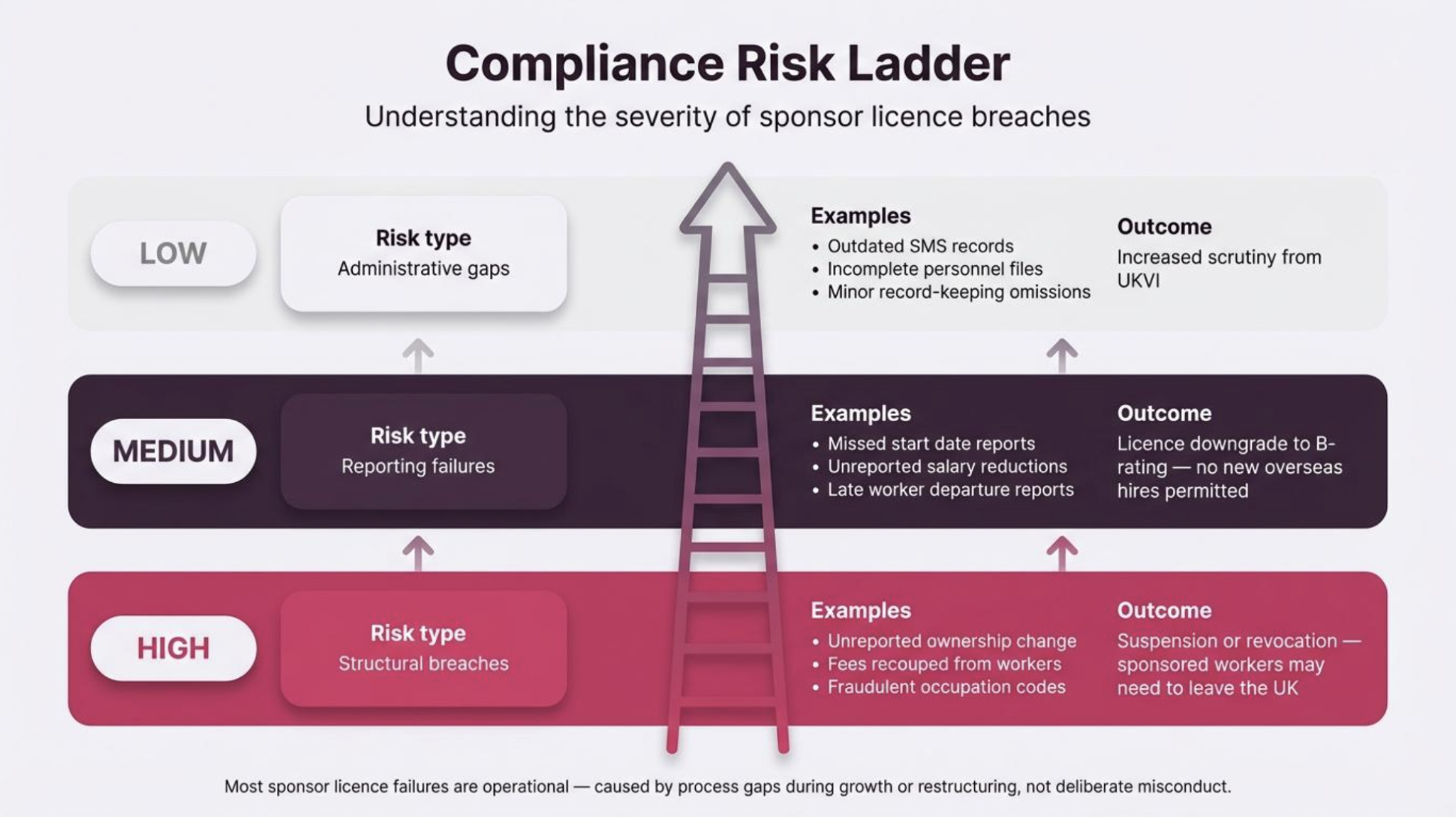
Enforcement actions
| Action | What it means |
|---|---|
| Rating downgrade (A to B) | You are placed on an action plan. You cannot bring in new workers from overseas. You must demonstrate compliance over a set period to regain your A-rating — and there is no guarantee. |
| Suspension | You cannot assign any new CoS while suspended. Existing workers are not immediately affected, but uncertainty around your licence status creates risk for everyone on it. |
| Revocation | Your licence is cancelled. Every worker you sponsor has their permission curtailed. They may need to leave the UK. Revocation is very difficult to challenge and very difficult to recover from. |
Automatic revocation triggers
Some breaches trigger automatic revocation where the Home Office has no discretion:
- Recouping CoS or licence fees from workers
- Assigning a CoS for a role that is not genuine
- Supplying workers as labour to a third party
- Failing to carry out right to work checks
- Underpaying workers below the route minimum without a valid exception
If you believe your licence may be at risk, contact Centuro immediately. Early intervention gives you options. Waiting does not.
Key timeframes
| Trigger | Deadline |
|---|---|
| Worker does not start within 28 days of permission being granted | Report within 10 working days of the grace period ending |
| Worker is absent without explanation or permission | Report within 10 working days |
| Worker leaves employment | Report within 10 working days |
| Worker’s role changes significantly | Report within 10 working days |
| Worker moves to a different location or branch | Report within 10 working days |
| Worker goes on statutory leave (maternity, paternity, etc.) | Report within 10 working days |
| New branch addition request (after worker starts there) | Submit within 20 working days |
| CoS must be used after assignment | Within 3 months |
| CoS allocation renewal (manual routes) | Up to 3 months before allocation year ends |
Common pitfalls
These are the failures we see most often. Most are avoidable.
- Start date changes not reported.
If a worker cannot start within 28 days of their permission being granted — even for a perfectly legitimate reason like a notice period — you must still report it. Many sponsors assume a good reason means no report is needed. It does not. - Salary decreases not reported.
Salary increases do not need reporting. Decreases do. From April 2026, the Home Office can check HMRC payroll data directly. They will find it. Report any reduction before it becomes a problem. - Company ownership change not handled correctly.
Licences are non-transferable. If your company is acquired, merges, or changes ownership, you cannot simply carry on with the existing licence. A new licence application is required. If this is not handled properly before the change completes, your licence can be revoked and your sponsored workers will lose their right to work. Tell Centuro early if you are going through any structural change. - Key Personnel not updated.
If your AO or a Level 1 User leaves and is not replaced in the SMS, you are operating with a compliance gap. Update the SMS when any Key Personnel changes. - Record-keeping gaps discovered at audit.
If you cannot produce a record during a compliance visit, it is treated as though it does not exist. Build record keeping into your HR processes, not your audit preparation. - Recouping fees from workers.
Any attempt to recover CoS or licence costs from a worker — directly or via salary deduction — results in automatic licence revocation. There are no exceptions.
Leadership actions
Sponsor compliance requires the same structured oversight as any other operational control. These are the actions that prevent failures before they happen.
- Treat sponsor compliance as a control framework. Assign ownership, set review cadences, and escalate exceptions — the same as you would for financial or data protection controls. It is not a task that can be delegated informally and forgotten.
- Ensure your Key Personnel are active and informed. Your AO and Level 1 Users must be current employees, correctly named in the SMS, and up to date with the latest guidance. An inactive AO is a compliance gap with no grace period.
- Implement structured monitoring. Track visa expiry dates, salary alignment with CoS records, and reportable event triggers proactively. Do not rely on individuals to remember deadlines under day-to-day pressure.
- Build record-keeping into normal HR processes. Records must be ready to produce at any time, not just assembled in the days before a compliance visit. If you cannot retrieve a record at short notice, it may as well not exist.
- Ensure board-level visibility of immigration risk. When your organisation is growing, restructuring, or changing ownership, these are the moments when sponsor obligations are most likely to be missed. Immigration compliance should be part of the conversation, not an afterthought.
Get our audit readiness checklist
Are you prepared for a UK Sponsor License audit? Find out with the help of the audit readiness checklist from our legal expert team.

By submitting this form, you agree that your details may be used to respond to your enquiry and to send you marketing communications from Centuro Global. You can update your preferences or unsubscribe at any time via our Preference Centre. See our Privacy Policy for more information.
Recent changes
This section reflects significant changes to sponsor obligations and will be updated as guidance changes.
April 2026 — HMRC Data Access
The Home Office now has direct access to HMRC payroll data. Salary compliance will be verified automatically against what is stated on each worker’s CoS. Underpayments will be identified without requiring a complaint or compliance visit.
March 2026 — Job duty changes must be reported
Any change to a sponsored worker’s job duties must now be reported via the SMS, even if the change does not meet the threshold for a formal change of employment application. Do not assume that a minor role adjustment does not need to be reported.
Book your consultation with Centuro Global
Centuro Global helps businesses obtain, audit and maintain their UK Sponsor Licence. We’ve successfully delivered thousands of licences for companies of all sizes, from fast-growing startups to global enterprises. Get in touch to book a call with our team.
This guide is based on UK government guidance current as of April 2026. Immigration rules change regularly. Verify current requirements with Centuro before acting on specific details.